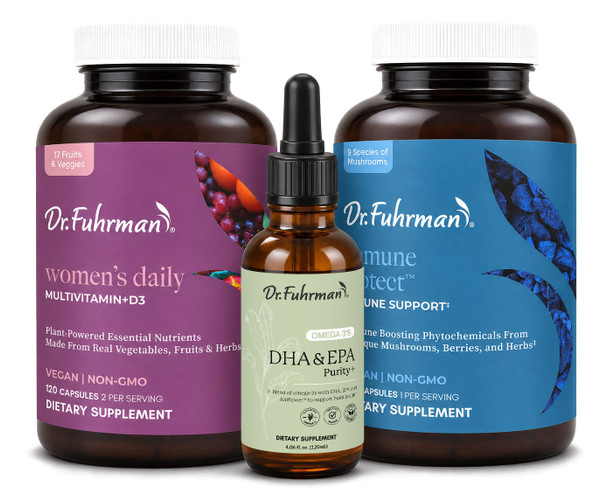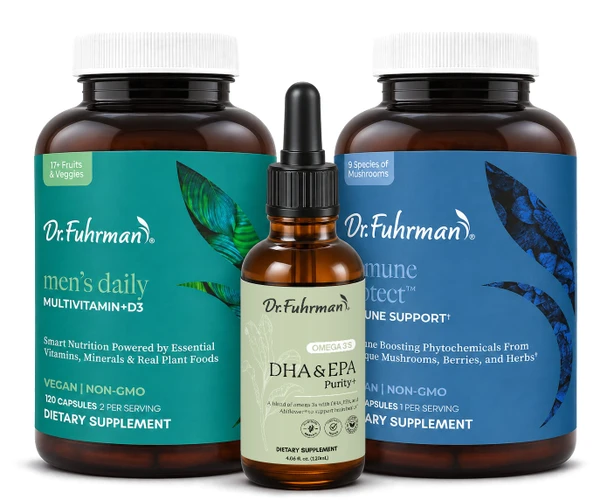


A Larger Daily Dosing & More than DHA and EPA; Now with Added Plant-Based Omegas
A Comprehensive, Clean and Vegan Source of Healthful Omega-3 Fatty Acids Derived from Microalgae and Ahiflower®
Crucial for brain health, eye vitality, and a robust nervous system, the omega-3 fatty acids DHA and EPA are vital nutrients. DHA & EPA Purity+ is perfect for everyone — whether you follow a plant-based diet or simply want a cleaner, more reliable way to get essential fatty acids without the chemical baggage of fish. While fish are traditionally known as a source of omega-3s, marine environments and fish tissues increasingly accumulate environmental contaminants, including pesticides and other industrial chemicals. DHA & EPA Purity+ supplies DHA and EPA rom microalgae, plus omega-3 ALA and SDA and the beneficial omega-6 fatty acid GLA from Ahiflower® for a healthy inflammatory response and excellent brain function throughout life. DHA & EPA Purity+ is packaged in dark glass and refrigerated at our warehouse for freshness and purity.
Bottle Contains 60-Day Supply
- Comprehensive vegan omega-3 fatty acid supplement including 250 mg ALA, 100 mg SDA, 140 mg EPA, and 280 mg DHA in each 2 ml serving
- DHA is a structural component of the brain, crucial for early neurological and visual development and cognitive function throughout life. DHA and EPA promote healthy cognitive function, memory, and mood
- SDA is a precursor to EPA that raises EPA levels more effectively than ALA
- Omega-3 fatty acids are important for healthy regulation and resolution of the inflammatory response
- ALA and the beneficial omega-6 fatty acid GLA promote skin health
- 100% vegan: EPA and DHA are derived from lab-grown algae and ALA, SDA, and GLA are derived from regeneratively farmed Ahiflower® – a cleaner alternative to eating fatty fish
- Fresh and refrigerated purified liquid concentrate
- Lemon oil provides a pleasant citrus flavor with no fishy taste
Key Ingredients
DHA
280 mg of purified liquid DHA (docosahexaenoic acid). Omega-3 DHA is a structural component of brain cell membranes, crucial for early neurological and visual development and cognitive function.
EPA
140 mg of EPA (eicosapentaenoic acid). Research suggests adequate EPA, which is also an important component of brain cell membranes, promotes a healthy mood. Both EPA and DHA help maintain proper regulation of the inflammatory response: Omega-6 and omega-3-derived molecules called eicosanoids and oxylipins regulate the body's inflammatory response, balancing pro- and anti-inflammatory influences. These molecules derived from EPA and DHA are either anti-inflammatory or act to resolve inflammation when it is no longer needed.
Ahiflower® oil
Regeneratively farmed Ahiflower® supplies 250 mg ALA, 100 mg of SDA, and 27 mg GLA per serving. In the process of elongation of ALA to EPA, conversion of ALA to SDA is the first step. But this conversion is most often inefficient. Human clinical trials have shown that SDA is more effective than ALA at increasing EPA levels, but does not raise DHA levels.
Whether intermediates such as SDA and DPA have separate roles from DHA and EPA or act only as precursors is not clear. There is some evidence that SDA could have beneficial effects on the microbiome. The conservative dose here will help ensure adequate levels of SDA itself, for conversion to EPA or other potential functions.
Together with a diet that includes ALA-rich seeds and nuts daily, comprehensive omega-3 supplementation combining SDA, EPA, and DHA supplies raw material at multiple steps in the elongation pathway, to ensure adequate levels of all the intermediates.
Frequently Asked Questions
Is DHA & EPA Purity+ third-party tested?
Yes. DHA & EPA Purity+ is third-party tested for heavy metals (arsenic, cadmium, lead, and mercury). Results are available upon request. Contact our Customer Service team.
How much DHA/EPA should I be taking?
DHA & EPA Purity+ comes with a dropper to make taking your 2 ml daily supply easy. Over time the dose can be adjusted to make sure your omega-3 index, a measurement of the % of total fatty acids in red blood cell membranes as EPA and DHA, is above 7.0%. Children can take 1 ml daily.
Do I need to supplement with omega 3 fatty acids even when I eat ground walnuts, flax, chia and hemp seeds daily?
Yes! ALA, a short-chain omega-3 found in certain plant foods, can be elongated by the body into DHA and EPA; however, even with an ideal diet, most people will not sufficiently convert ALA to achieve optimal amounts of long-chain omega-3 (DHA and EPA) to prevent brain shrinkage and dementia with aging. Supplementing DHA & EPA Purity+ with a high nutrient, plant-based diet will enhance the health benefits of your diet. While plant-based foods like flax seeds and walnuts offer some short-chain omega-3 ALA,, many factors including genetics, sex, and dietary factors affect how much ALA can be converted to EPA and DHA, and it is likely inadequate for most of us to reach an omega-3 index associated with later life brain health. Supplementation studies in humans have consistently shown that taking ALA does not increase the omega-3 index. There are a minimum of eight human studies that document a low omega-3 index is linked to brain shrinkage or cognitive impairment with aging.
By bypassing the first step in the elongation pathway, SDA is more efficiently converted to EPA than ALA. However, the same enzyme is needed again later in the pathway to get from DPA to DHA. This is why SDA does not raise DHA levels, and highlights why pre-formed DHA is needed for most of us.
How can I test my omega 3 fatty acid levels?
You can test your omega-3 index at home with this kit.
What should my omega-3 index levels be?
Your omega-3 index should be between 7% and 9%.
Is it more beneficial to take omega-3s from fish or algae?
Our algal oil is in the natural triglyceride form that is present in fatty fish. Refrigerated algae oil is the cleanest source, with the least amount of rancidity.
What steps do you take to preserve the freshness of the omega-3 oil?
We use a highest quality, concentrated form of DHA and EPA, combine it with Ahiflower® oil, package it in dark glass (not plastic), and then store the bottles refrigerated to maintain freshness. We also include antioxidants (vitamin C and mixed tocopherols) to prevent oxidative damage to the omega-3 fatty acids. You simply can't get a fresher omega-3 supplement anywhere. When you receive your bottle, we recommend storing it in the refrigerator.
Is DHA & EPA Purity+ gluten-free? Allergen-free?
DHA & EPA Purity+ does not contain wheat, gluten, dairy, soy, peanuts, tree nuts, fish, shellfish, or sesame. DHA & EPA Purity+ is not manufactured in an allergen-free or gluten-free facility. Our manufacturing facility has an allergen control program in place designed to properly handle, store and use materials in production to eliminate the risk of cross-contamination, in accordance with Good Manufacturing Practices (GMPs).
What Makes Dr. Fuhrman Supplements Unique?
Dr. Fuhrman supplements stand out in the crowded marketplace due to their unique formulation of high-quality ingredients and evidence-based approach. Dr. Fuhrman supplements are designed based on extensive scientific research and clinical experience. All formulations are produced in a GMP certified facility.
What research went into this product?
Below are some of the studies that informed the development of this product:
1. Office of Dietary Supplements, National Institutes of Health. Omega-3 Fatty Acids. Fact Sheet for Health Professionals [https://ods.od.nih.gov/factsheets/Omega3FattyAcids-HealthProfessional/]
2. Harris WS, Tintle NL, Imamura F, et al. Blood n-3 fatty acid levels and total and cause-specific mortality from 17 prospective studies. Nature Communications 2021, 12:2329.
3. Wei BZ, Li L, Dong CW, et al. The Relationship of Omega-3 Fatty Acids with Dementia and Cognitive Decline: Evidence from Perspective Cohort Studies of Supplementation, Dietary Intake, and Blood Markers. Am J Clin Nutr 2023.
4. von Schacky C. Importance of EPA and DHA Blood Levels in Brain Structure and Function. Nutrients 2021, 13:1074.
5. Dyall SC. Long-chain omega-3 fatty acids and the brain: a review of the independent and shared effects of EPA, DPA and DHA. Front Aging Neurosci 2015, 7:52.
6. DiNicolantonio JJ, O'Keefe JH. The Importance of Marine Omega-3s for Brain Development and the Prevention and Treatment of Behavior, Mood, and Other Brain Disorders. Nutrients 2020, 12.
7. Larrieu T, Laye S. Food for Mood: Relevance of Nutritional Omega-3 Fatty Acids for Depression and Anxiety. Front Physiol 2018, 9:1047.
8. Lefort N, LeBlanc R, Surette ME. Dietary Buglossoides Arvensis Oil Increases Circulating n-3 Polyunsaturated Fatty Acids in a Dose-Dependent Manner and Enhances Lipopolysaccharide-Stimulated Whole Blood Interleukin-10-A Randomized Placebo-Controlled Trial. Nutrients 2017, 9.
9. Lefort N, LeBlanc R, Giroux MA, Surette ME. Consumption of Buglossoides arvensis seed oil is safe and increases tissue long-chain n-3 fatty acid content more than flax seed oil - results of a phase I randomised clinical trial. J Nutr Sci 2016, 5:e2.
10. Seidel U, Eberhardt K, Wiebel M, et al. Stearidonic acid improves eicosapentaenoic acid status: studies in humans and cultured hepatocytes. Frontiers in Nutrition 2024, Volume 11 - 2024.
11. Calder PC. Omega-3 fatty acids and inflammatory processes. Nutrients 2010, 2:355-374.
12. Otten JJ, Hellwig JP, Meyers LD: Dietary Reference Intakes: The Essential Guide to Nutrient Requirements. Institute of Medicine; 2006.
13. Parke MA, Perez-Sanchez A, Zamil DH, Katta R. Diet and Skin Barrier: The Role of Dietary Interventions on Skin Barrier Function. Dermatol Pract Concept 2021, 11:e2021132.
14. Balić A, Vlašić D, Žužul K, et al. Omega-3 Versus Omega-6 Polyunsaturated Fatty Acids in the Prevention and Treatment of Inflammatory Skin Diseases. International Journal of Molecular Sciences 2020, 21:741.
15. Sergeant S, Rahbar E, Chilton FH. Gamma-linolenic acid, Dihommo-gamma linolenic, Eicosanoids and Inflammatory Processes. Eur J Pharmacol 2016, 785:77-86.
16. Liao Y, Xie B, Zhang H, et al. Efficacy of omega-3 PUFAs in depression: A meta-analysis. Transl Psychiatry 2019, 9:190.
17. Kuhnt K, Weiß S, Kiehntopf M, Jahreis G. Consumption of echium oil increases EPA and DPA in blood fractions more efficiently compared to linseed oil in humans. Lipids Health Dis 2016, 15:32.
18. Harris WS, Lemke SL, Hansen SN, et al. Stearidonic Acid-Enriched Soybean Oil Increased the Omega-3 Index, an Emerging Cardiovascular Risk Marker. Lipids 2008, 43:805-811.
19. Lemke SL, Vicini JL, Su H, et al. Dietary intake of stearidonic acid-enriched soybean oil increases the omega-3 index: randomized, double-blind clinical study of efficacy and safety. Am J Clin Nutr 2010, 92:766-775.
20. Roussel C, Sola M, Lessard-Lord J, et al. Human gut microbiota and their production of endocannabinoid-like mediators are directly affected by a dietary oil. Gut Microbes 2024, 16:2335879.
21. Davis BC, Kris-Etherton PM. Achieving optimal essential fatty acid status in vegetarians: current knowledge and practical implications. Am J Clin Nutr 2003, 78:640S-646S.
22. Sarter B, Kelsey KS, Schwartz TA, Harris WS. Blood docosahexaenoic acid and eicosapentaenoic acid in vegans: Associations with age and gender and effects of an algal-derived omega-3 fatty acid supplement. Clin Nutr 2014.
23. Lane KE, Wilson M, Hellon TG, Davies IG. Bioavailability and conversion of plant based sources of omega-3 fatty acids - a scoping review to update supplementation options for vegetarians and vegans. Crit Rev Food Sci Nutr 2022, 62:4982-4997.
24. Bowman GL, Dodge HH, Mattek N, et al. Plasma omega-3 PUFA and white matter mediated executive decline in older adults. Front Aging Neurosci 2013, 5:92.
25. Tan ZS, Harris WS, Beiser AS, et al. Red blood cell omega-3 fatty acid levels and markers of accelerated brain aging. Neurology 2012, 78:658-664.
26. Pottala JV, Yaffe K, Robinson JG, et al. Higher RBC EPA + DHA corresponds with larger total brain and hippocampal volumes: WHIMS-MRI study. Neurology 2014, 82:435-442.
27. Thomas A, Baillet M, Proust-Lima C, et al. Blood polyunsaturated omega-3 fatty acids, brain atrophy, cognitive decline, and dementia risk. Alzheimers Dement 2020.
28. Rouch L, Virecoulon Giudici K, Cantet C, et al. Associations of erythrocyte omega-3 fatty acids with cognition, brain imaging and biomarkers in the Alzheimer's disease neuroimaging initiative: cross-sectional and longitudinal retrospective analyses. Am J Clin Nutr 2022, 116:1492-1506.
29. Loong S, Barnes S, Gatto NM, et al. Omega-3 Fatty Acids, Cognition, and Brain Volume in Older Adults. Brain Sci 2023, 13.
30. Virtanen JK, Siscovick DS, Lemaitre RN, et al. Circulating Omega-3 Polyunsaturated Fatty Acids and Subclinical Brain Abnormalities on MRI in Older Adults: The Cardiovascular Health Study. Journal of the American Heart Association 2013, 2:e000305.
31. Lukaschek K, von Schacky C, Kruse J, Ladwig KH. Cognitive Impairment Is Associated with a Low Omega-3 Index in the Elderly: Results from the KORA-Age Study. Dement Geriatr Cogn Disord 2016, 42:236-245.